Therapeutic Riding
Therapeutic Equine Programme Complaints Policy and Procedure
Make a complaint
You can complain in person, by phone, by WhatsApp, by email or using our online complaint form. Please raise it as soon as possible, and normally within 30 days of the event.
Complete the online complaint form
Or contact the programme directly:
To email us, please turn on JavaScript, or call or WhatsApp the number below.
Phone or WhatsApp: 056 680 4863
The programme is closed on Saturdays and Sunday mornings, so messages received then are picked up on the next working day. If anyone is at immediate risk of harm, call 999 for police or 998 for an ambulance.
1. Purpose and scope
This policy sets out how the Therapeutic Equine Programme at Abu Dhabi Equestrian Club receives, investigates and resolves complaints fairly, promptly and in confidence.
It applies to complaints from participants, parents, carers, guardians, volunteers, referral partners and members of the public about any part of the programme, including:
- the quality, safety or delivery of sessions
- the conduct of instructors, grooms, volunteers or other staff
- the welfare, suitability or handling of the programme horses
- communication, scheduling, cancellations and administration
- facilities, equipment and accessibility
Staff grievances are not covered and follow ADEC Human Resources procedures. Safeguarding concerns follow the Safeguarding Policy first, as set out in Section 7.
2. Policy statement and principles
ADEC welcomes feedback and treats every complaint as an opportunity to improve the programme.
No participant shall be treated unfavourably solely for making a complaint in good faith. This does not prevent ADEC from taking appropriate action for legitimate safety or welfare reasons.
Every complaint is handled in line with these principles:
- Fair: everyone involved is heard, and decisions are based on facts and evidence.
- Timely: complaints are acknowledged and resolved within the timescales in Section 6.
- Confidential: information is shared only with those who need it to resolve the complaint.
- Accessible: complaints can be made in English or Arabic, verbally or in writing, and help is given to anyone who needs support to make one.
- Participant-centred: the safety and welfare of participants and horses always come first.
- Accountable: every complaint is recorded, and lessons learned are acted on.
The programme follows PATH International and Riding for the Disabled Association standards and guidelines. This policy operates alongside theĀ ADEC Safeguarding Policy, the ADEC Participant and Volunteer Policy and Disclaimer, and ADEC Human Resources procedures.
3. Definitions
| Term | Meaning |
|---|---|
| Complaint | An expression of dissatisfaction, verbal or written, about the programme, its staff, volunteers, horses or facilities, which needs a response. |
| Concern | An informal query or worry raised for a quick answer. A concern becomes a complaint if it is not resolved or the person asks for it to be treated as one. |
| Complainant | The person making the complaint, or someone acting on their behalf with their consent. |
| Participant | A person attending programme sessions, also known as a rider or beneficiary. |
| Working day | Sunday to Friday, excluding UAE public holidays. The programme is closed on Saturdays and Sunday mornings. |
4. Roles and responsibilities
| Role | Name | Responsibilities |
|---|---|---|
| Chief Executive Officer and Programme Manager | Dayle Brown | Overall accountability for this policy. Hears Stage 3 reviews and makes the final decision. Investigates any complaint about the Head Instructor. Decides how referral and funding partners are informed. Approves changes to the policy. |
| Head Instructor | Faye Galvin | Day to day owner of the procedure. Assesses every complaint for safeguarding risk, resolves Stage 1 complaints and investigates Stage 2 complaints. Keeps the Complaints Log up to date and reports to the Chief Executive Officer monthly. |
| Programme Administrator and Coordinator | Cathy Valenzona | Receives and logs complaints, sends acknowledgements, arranges meetings and keeps all records filed securely. |
| Instructors, grooms and volunteers | All | Listen calmly, resolve minor concerns on the spot where possible, pass every complaint to the Head Instructor on the same day and cooperate fully with any investigation. |
No one investigates a complaint about themselves. A complaint about the Head Instructor goes straight to the Chief Executive Officer. A complaint concerning the Chief Executive Office or Head Instructor shall be referred to ADEC’s Director General or another independent senior officer designated by ADEC.
5. How to make a complaint
Complaints can be made in person, by phone, by WhatsApp, by email or in writing using our online complaint form. They should be raised as soon as possible, and normally within 30 days of the event.
- At a session: speak to the instructor leading the session or the Head Instructor.
- By phone, WhatsApp or email: use the Email us button at the top of this page, or call or WhatsApp 056 680 4863. The programme is closed on Saturdays and Sunday mornings, so messages received then are picked up on the next working day.
A complaint should include:
- the complainant’s name and contact details
- the participant’s name
- the date, time and place of what happened
- what happened and who was involved
- the outcome the complainant would like
A verbal complaint is written up by the staff member who receives it, read back to the complainant to confirm it is accurate, and logged on the same day.
Anonymous complaints are recorded and looked into where possible, but a response cannot be given.
A complaint copied to partners such as Ma’an or Mubadala Foundation is still handled under this procedure. The Chief Executive Officer decides how partners are kept informed.
6. Complaints procedure
Every complaint moves through up to three stages, and most should be resolved at Stage 1.
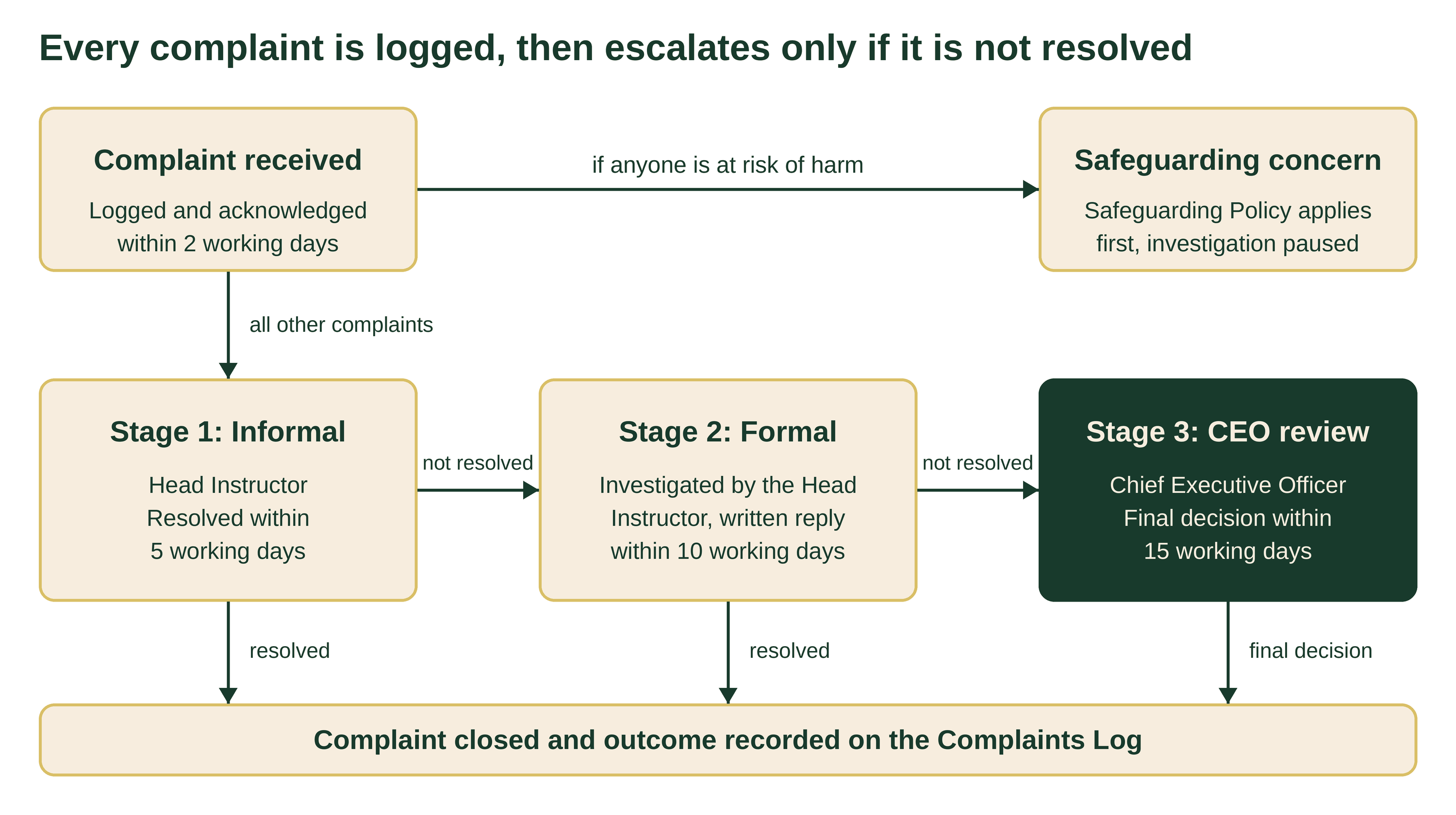
A safeguarding concern leaves the procedure at once and follows Section 7.
Receiving and logging
- The complaint is entered on the Complaints Log on the day it is received and given a reference number.
- The complainant receives a written acknowledgement within 2 working days, naming who will handle the complaint and when to expect a reply.
- The Head Instructor checks whether it raises a safeguarding or welfare concern. If it does, Section 7 applies first.
Stage 1: Informal resolution
- Handled by: the Head Instructor
- Timescale: resolved within 5 working days of acknowledgement
- What happens: the Head Instructor speaks or meets with the complainant, listens, explains what happened and agrees any action. The outcome is confirmed in writing by WhatsApp or email and recorded on the log.
Stage 2: Formal investigation
- Applies when: Stage 1 does not resolve the complaint, the complaint is serious, or the complainant asks for a formal investigation
- Handled by: the Head Instructor, or the Chief Executive Officer if the complaint concerns the Head Instructor
- Timescale: written response within 10 working days of the formal complaint being received
- What happens: the investigator reviews session notes, records and correspondence, takes written statements from staff, volunteers and witnesses, and may meet the complainant. The written response sets out the findings, whether the complaint is upheld, partly upheld or not upheld, any actions taken, and how to request a Stage 3 review.
Stage 3: Review by the Chief Executive Officer
- Applies when: the complainant is not satisfied with the Stage 2 outcome and asks for a review in writing within 10 working days of receiving it
- Handled by: Dayle Brown, Chief Executive Officer
- Timescale: final written decision within 15 working days of the review request
- What happens: the review checks that the procedure was followed and that the outcome was fair. It may include a meeting with the complainant and the Head Instructor. The decision includes ADEC’s internal complaints procedure, without affecting any rights or remedies available under applicable law.
If a time scale cannot be met, for example because a witness is away, the complainant is told in writing why and given a new date.
7. Safeguarding, welfare and serious incidents
Any complaint suggesting that a participant, volunteer or staff member is at risk of harm is treated as a safeguarding concern first and a complaint second.
- The person receiving it tells the Head Instructor immediately, and the ADEC Safeguarding Policy is followed.
- In an emergency, call 999 for police or 998 for an ambulance.
- The complaint investigation is paused until the safeguarding process allows it to continue, and the complainant is told this.
- Any injury to a participant, volunteer, staff member or horse, including a bite or kick, is recorded on an Incident Report on the same day and reported to the Chief Executive Officer within 24 hours.
- A complaint about horse welfare is reviewed by the Head Instructor, with veterinary advice where needed. The horse may be rested from sessions while the matter is reviewed.
8. Confidentiality, records and data
- All complaints are recorded on the Complaints Log, which only the Chief Executive Officer, Head Instructor and Programme Administrator can access.
- Complaint forms, statements, correspondence and outcomes are stored securely and filed with the participant’s confidential beneficiary record.
- Records are kept and disposed of in line with ADEC’s records retention policy.
- Personal data shall be handled in accordance with applicable UAE data protection laws and ADEC’s relevant policies.
- Staff and volunteers must not discuss a complaint with other families, outside the team or on social media.
9. Unreasonable or persistent complaints
Most complaints are reasonable, but ADEC may limit contact with a complainant who:
- is abusive, threatening or discriminatory towards staff, volunteers or other families
- repeatedly raises substantially the same complaint after its final resolution without providing any new relevant information.
Any restriction shall not prevent the reporting of new incidents, safeguarding concerns or matters to competent authorities.
Any restriction is decided by the Chief Executive Officer, confirmed in writing with the reason, and reviewed after 3 months. Staff and volunteers are supported throughout, and their wellbeing is taken into account.
10. Learning, monitoring and reviewing
- The Head Instructor reviews the Complaints Log monthly and reports to the Chief Executive Officer on the number of complaints, themes, outcomes and actions.
- Lessons learned are shared at team meetings and built into staff and volunteer training.
- A summary of complaints and actions is included in partner reporting to Ma’an and Mubadala Foundation where appropriate.
- This policy is reviewed every year, or sooner after a serious complaint or a change in law or guidance.
Document control
| Policy owner | Faye Galvin, Head Instructor |
| Approved by | Dayle Brown, Chief Executive Officer |
| Version | 1.0, draft for approval |
| Date drafted | 1 November 2026 |
| Next review | November 2027 |
